
Click here to order signed, personalized copies directly from Sean
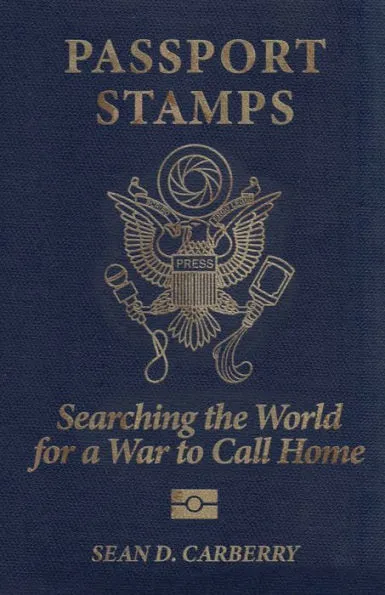
Passport Stamps: Searching the World for a War to Call Home
A poignant, gritty memoir of a disillusioned reporter. Carberry never imagined himself a journalist, let alone a war correspondent who’d spend years in some of the most dangerous places in the world. As a Gold Record–winning audio engineer and record producer, he produced the radio show The Connection, aired by Boston’s National Public Radio. Following a traumatic personal experience and the 9/11 terrorist attacks and subsequent war in Afghanistan, he felt called by “a sense of public duty” to shift careers. More than a decade later, as a Peabody Award–winning journalist for NPR, the author offers a “Bourdain-esque travel book” that takes readers on an international tour that juxtaposes the “dust, grit, ragged infrastructure…and way too much food poisoning” of war-torn nations with the “beauty, humanity, generosity, [and] kindness” of people (and cats) encountered along the way. Aside from occasional stints in the Democratic Republic of the Congo, Serbia, and Washington, D.C., most of the book takes place in North Africa and the Middle East as Carberry covers the genocide in Sudan’s Darfur region and America’s wars in Afghanistan and Iraq. It’s an intimate book—much of the narrative focuses on the author battling his own personal demons, and Carberry openly discusses sensitive topics that include post-traumatic stress disorder, suicidal ideations, gruesome violence, and loneliness. With an advanced degree from the Harvard Kennedy School and a career that included a stint at the Department of Defense, the author has a firm grasp on historical context and international politics. As such, he offers a well-informed, probing commentary on American foreign policy in the 21st century as well as a behind-the-scenes look at modern journalism, which, he notes, is often based on “dumb luck.” Citing Hunter S. Thompson and Warren Zevon (who provided “the soundtrack to this book”) as his influences, Carberry relates globe-hopping, often chaotic anecdotes that effectively evoke both his internal turmoil and the existential dangers that surrounded him for years.
Order the book





What people are saying about Passport Stamps
I wasn’t who I was because I was a journalist, I was a journalist because of who I am.” We need such journalists. Sean Carberry has written a brave book for which there are no passport stamps—the soul highs and lows of intoxicating faith leaping around dangerous combat zones on a years-long adrenalin rush. This is a clarion call for better mental health treatment after a confusing exodus from that world, where writing knits together that which is frayed and keeps indelible experiences on the shelves of story, always.
—Jacki Lyden, author of Daughter of the Queen of Sheba and former NPR host and correspondent
Of immense value to readers with an interest in contemporary battlefield journalism, “Passport Stamps: Searching the World for a War to Call Home” is as inherently fascinating as it is impressively informative. Exceptionally well written, organized and presented, “Passport Stamps” is a unique and unreservedly recommended addition to professional, community, and academic library Journalism collections and supplemental curriculum studies lists. It should be noted for journalism students, academia, and non-specialist general readers with an interest in the subject that “Passport Stamps” is also readily available in a digital book format.
—Michael Dunford, Reviewer, Midwest Book Review
Passport Stamps brings to mind Gale Garnett’s “We’ll Sing in the Sunshine.” Carberry describes the evanescence of sunshine and darkness followed by the inevitable being “on the way” of a journalist. Carberry’s world is a tattered web of people and places: Serbia, Russia, Egypt, Colombia, Lebanon, Syria, Yemen, Afghanistan—our simultaneously horrifying yet alluring broken globe. Passport Stamps records Carberry’s memories—accounts which make the reader ache for his forgotten life, real or imagined. It is a sharp, raking marvelous travel book, an autobiography rich with detail and ponderings about life.
—Sam Pickering, Author of The Gate in the Garden Wall
A lot of journalists come back from covering war and disaster and write the book about what they saw. Sean Carberry tells a different story—about what goes on inside of such a reporter’s mind out there. Hopes, dreams, fears, embarrassment, hard lessons. It’s all there, and it’s quite a yarn.
Passport Stamps tells the story of a wartime journalist earning his stripes… a man’s search for fulfillment, adventure, and companionship. Carberry relays what it was that first motivated him to become a war journalist and then also how the experience changed him as a person who increasingly comes to weigh the costs of his desire to write a good story against his knowledge that in a warzone, a good story means violence, and violence always has a human cost.
—Michael Hilbig, Author of Judgment Day and Other White Lies